Los Angeles Lighting Mfg. Co.

MADE IN AMERICA
COMMERCIAL & INDUSTRIAL
STANDARD & CUSTOM LUMINAIRES

Uncategorized

Key Considerations for Lighting in Schools

Smart, Durable, and Flexible: What Lighting Professionals Need to Know About School Projects

When it comes to lighting school environments, there is a unique combination of technical, architectural, and logistical challenges. For over 35 years, L.A. Lighting has worked closely with school districts to meet those challenges head-on—providing reliable, long-lasting solutions designed with both performance and practicality in mind.

Retrofitting Fluorescents the Smart Way

Much of the current work in schools revolves around retrofitting inefficient fluorescent systems. Upgrading to LED can save schools significant amounts on energy costs, in addition to lowering maintenance expenses by ending the need to regularly change fluorescent bulbs.

With limited time and funding for school renovations, an LED retrofit product should be easy to install. Our retrofit kits are designed to be installed in as little as five minutes by simply removing existing fluorescent components and screwing a pre-wired LED board and driver assembly into the housing using self-drilling screws. Features like safety cables, rounded corners, and driver disconnects reduce accidents and help speed up the process even further.

BCL100 Canopy Luminaire

Sensors and Controls are the Key to Greater Savings 

Smart sensors and controls open up a world of possibilities for schools to save energy. A typical school fixture like our BCL100 canopy luminaire may feature both a motion sensor and a photocell, enabling automatic daylight harvesting and bi-level dimming. For example, a luminaire equipped with our MSHSD sensor can adjust lumen output based on both motion and ambient light, providing full brightness only when someone is present and daylight is insufficient.

One often-overlooked detail in school lighting is the importance of sensor placement. In school environments, vandal resistance is key. Traditional sensors mounted externally on fixture end caps can be easy targets. That’s why we’ve designed several fixture models, like the WHO200 impact-resistant wraparound, that have space behind the lens to mount microwave motion sensors. These specialized sensors detect motion through low-density plastic, allowing them to be hidden from view and protected from abuse, while still providing effective motion sensing. It’s a detail that enhances durability without compromising functionality.
 

Meeting District-Specific Specs and Prioritizing Flexibility 

Another area where we’ve refined our approach is in meeting hyper-specific district requirements. From gauge thickness and tamper-proof screws to door frame materials and hinge types, schools often have specific requirements intended to increase durability, and L.A. Lighting is delivering. In fact, some of these tailored configurations have resulted in exclusive, district-specific SKUs that allow us to hit the precise specs schools require.

Flexibility is another key ingredient when working with schools. Whether this means creating a custom housing or using specialized component, L.A. Lighting maintains a flexible approach. For example, we’ve seen increased demand for DMX drivers for use in theater applications. Providing these advanced systems has allowed schools to use L.A. Lighting fixtures with existing DMX-based lighting controllers- a perfect example of how lighting manufacturers must remain agile and ready to pivot based on application-specific needs.

Logistics and Labeling—Not Afterthoughts 

The logistics of working with school districts requires attention to detail. We’ve accommodated requests ranging from color-coded box labels (to differentiate contractor vs. in-house installations) to specialized job packing. For local projects on tight timelines, we offer shrink-wrapped pallet delivery—cutting down on packaging waste and installation time when fixtures are being installed immediately.

We also support direct will-call pickups for maintenance staff, helping them bypass distributor deliveries when time is tight. These small operational tweaks can make a big difference for facilities teams coordinating complex renovations on tight schedules.

Conclusion: Lighting for Schools is all About Versatility

Lighting for schools isn’t just about illumination—it’s about designing systems that meet evolving technical standards, endure physical demands, and integrate seamlessly with modern control systems. By focusing on retrofit versatility, control compatibility, and logistics flexibility, we’re helping districts transition into the next generation of lighting—one smart fixture at a time.

Key Considerations for Lighting in Schools Read More »

Total Cost of Ownership- LA Lighting vs Imports

When it comes to selecting lighting products, up-front costs are just part of the picture. For the full story, we need to take a deeper look.

INTRODUCTION

When selecting lighting fixtures for commercial, industrial, or institutional projects, it’s common to focus solely on the sticker price. However, the true financial impact of a lighting solution is better understood by analyzing its Total Cost of Ownership (TCO)—a calculation that factors in not only the initial cost but also energy usage, maintenance, component reliability, and operational risks over the fixture’s lifetime. 

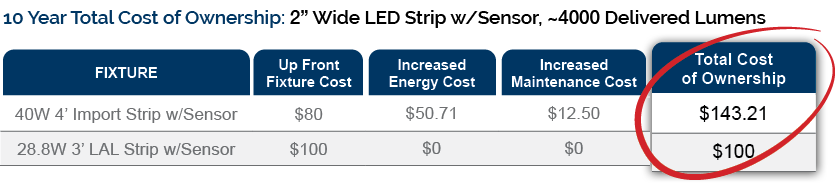
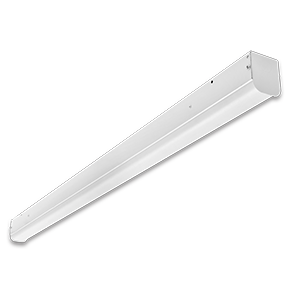
LA Lighting, a leading U.S. manufacturer based in El Monte, California, produces all its fixtures domestically using premium, top-tier components. In this article, LA Lighting will compare the 10-year TCO of one of its fixtures, the STW100 3’ 28.8W 4000 Lumen Strip, to an imported fixture from an undisclosed brand (referred to here as Brand C), the 4’ 40W 4000 Lumen Strip. 


We’ll explore and quantify costs across three primary topics:

  • Up-Front Fixture Cost 
  • Energy Cost Over 10 Years 
  • Maintenance and Component Failure Costs Over 10 Years 

We’ll also explore other costs which can create significant premiums hidden in import fixtures without adding them to the final TCO. For helpful links, see the Appendix at the bottom of the page.

FIXTURE PRICE: UPFRONT COSTS VS. LONG-TERM VALUE

LA Lighting fixtures often come with a higher upfront cost when compared to imported alternatives. This is especially evident when not accounting for recent and upcoming tariff increases in 2025, which significantly impact the final price of imported goods. 

The cost premium on LA Lighting fixtures is not primarily due to higher U.S. labor rates, as commonly assumed. Instead, it reflects the use of superior components: 

  • Name-brand, UL-listed LED drivers 
  • High-efficacy LED boards with solid metal cores 
  • Premium U.S.-sourced steel and plastics 
  • Advanced sensors and emergency battery systems

While imports may seem cheaper, the investment in quality components pays off in reliability and long-term savings. 

FIXTURE SIZE AND DESIGN EFFICIENCY

A major cost advantage of LA Lighting is its compact, high-output designs. Thanks to advanced LED boards and metal core technology, LA Lighting can achieve: 

  • 4000 lumens from a 3’ strip 
  • Up to 6000+ lumens from a 2’ or 3’ fixture 
  • Up to 50% higher efficiencies 

By contrast, Brand C needs a 4’ fixture to achieve the same output. This not only increases material costs (steel, plastic, shipping) but also limits design flexibility. 

ENERGY CONSUMPTION: SAVINGS THAT COMPOUND YEAR OVER YEAR

Energy efficiency is a defining feature of LA Lighting fixtures. While Brand C uses LEDs with a 105 lm/W output, LA Lighting delivers 135 lm/W—a 28% increase in delivered efficiency. 

Power Consumption Details 

  • LA Lighting STW100: 28.8W (.028kW) 
  • Brand C Strip: 40W (.04kW) 
  • Delta: 11.2W (0.0112 kW) 

Assuming 2000 annual operating hours, based on a facility with 4000 hours but using occupancy sensors to cut runtime by 50%, here are the annual savings:


10-Year Energy Cost Savings (@ $0.15/kWh): 

Total 10-Year Energy Savings per Fixture: $50.71 


These calculations do not include additional savings from LA Lighting’s high-performance occupancy sensors, which further reduce operating hours due to better detection and longer durability—often cutting usage by another 10–20%. 

Year Annual Cost Savings
Year 1 $4.03
Year 2 $4.23
Year 3 $4.45
Year 4 $4.67
Year 5 $4.90
Year 6 $5.15
Year 7 $5.40
Year 8 $5.67
Year 9 $5.96
Year 10 $6.25

MAINTENANCE AND COMPONENT QUALITY: RELIABILITY THAT PAYS OFF

One of the largest hidden costs in lighting systems is maintenance, especially when using low-cost, unreliable components common in imported fixtures. LA Lighting uses only UL-listed, name-brand components with 5-year minimum warranties. 

Maintenance Cost Over 10 Years (Per Fixture) 

  • Driver Replacement: $25 part + $100 labor = $125 (10% failure rate) → $12.50 avg. 
  • Battery Replacement: $100 part + $100 labor = $200 (10% failure rate) → $20.00 avg. 

Total 10-Year Maintenance Savings: $32.50 per fixture 

Note: These values are conservative. Real-world data suggests import failure rates can exceed 30-50%, particularly for drivers and batteries. This value of $32.50 was also downgraded to $12.50 to show a conservative total value. 

BUILD QUALITY: STEEL AND PLASTICS THAT LAST

Steel 

Many fixtures claim to use “22Ga steel,” but imports often cut corners, using lower-grade or thinner steel. LA Lighting uses true-gauge U.S.-made steel, offering greater impact resistance, less deformation during maintenance, and better longevity under stress.


Plastics 

Imported plastics frequently contain unregulated additives like styrene or recycled acrylics, which degrade over time. This leads to yellowing, brittleness, and cracking under minor pressure. 

In contrast, LA Lighting uses virgin acrylic with DR (durability reinforcement) additives for a long-lasting finish that holds up over decades. 

PROJECT RISK: DOWNTIME IS EXPENSIVE

Project rollouts involving overseas components introduce significant supply chain risks: 

  • Product discontinuation
  • Delayed replacements
  • Manufacturer shutdowns 

These risks can easily create costly delays stemming from missed deadlines, fines, liquidated damages, and idle labor and rental equipment costs. While these aren’t included in the TCO calculation, they pose real-world financial risks.

CUSTOMIZABILITY: GET WHAT YOU NEED, NOT WHAT YOU’RE FORCED TO BUY

Imported lighting fixtures are mass-produced in a few standard models. If those don’t meet your needs, you’re out of luck. 

LA Lighting offers true customizability: 

  • Custom lengths and widths 
  • Specific lumen packages 
  • Tailored drivers, LEDs and sensors 

This means you can purchase a smaller, more cost-effective fixture that perfectly matches your application instead of overspending on stock options. 

CONCLUSION

While imported fixtures may seem appealing at first glance, the Total Cost of Ownership tells a different story. With LA Lighting, customers benefit from: 

  • Superior efficiency and durability 
  • Lower maintenance and repair costs 
  • Customizability and risk reduction 
  • A reliable domestic supply chain 

The upfront cost is an investment—one that pays dividends in performance, reliability, and long-term savings. So choose smarter. Choose American-made. Choose LA Lighting.

Total Cost of Ownership- LA Lighting vs Imports Read More »

Scroll to Top